 Add to Chrome
 Add to Firefox
 Add to Edge
Visually-Guided Policy Optimization for Multimodal Reasoning
Apr 10, 2026
Reinforcement learning with verifiable rewards (RLVR) has significantly advanced the reasoning ability of vision-language models (VLMs). However, the inherent text-dominated nature of VLMs often leads to insufficient visual faithfulness, characterized by sparse attention activation to visual tokens. More importantly, our empirical analysis reveals that temporal visual forgetting along reasoning steps exacerbates this deficiency. To bridge this gap, we propose Visually-Guided Policy Optimization (VGPO), a novel framework to reinforce visual focus during policy optimization. Specifically, VGPO initially introduces a Visual Attention Compensation mechanism that leverages visual similarity to localize and amplify visual cues, while progressively elevating visual expectations in later steps to counteract visual forgetting. Building on this mechanism, we implement a dual-grained advantage re-weighting strategy: the intra-trajectory level highlights tokens exhibiting relatively high visual activation, while the inter-trajectory level prioritizes trajectories demonstrating superior visual accumulation. Extensive experiments demonstrate that VGPO achieves better visual activation and superior performance in mathematical multimodal reasoning and visual-dependent tasks.

AlignCoder: Aligning Retrieval with Target Intent for Repository-Level Code Completion
Jan 27, 2026Repository-level code completion remains a challenging task for existing code large language models (code LLMs) due to their limited understanding of repository-specific context and domain knowledge. While retrieval-augmented generation (RAG) approaches have shown promise by retrieving relevant code snippets as cross-file context, they suffer from two fundamental problems: misalignment between the query and the target code in the retrieval process, and the inability of existing retrieval methods to effectively utilize the inference information. To address these challenges, we propose AlignCoder, a repository-level code completion framework that introduces a query enhancement mechanism and a reinforcement learning based retriever training method. Our approach generates multiple candidate completions to construct an enhanced query that bridges the semantic gap between the initial query and the target code. Additionally, we employ reinforcement learning to train an AlignRetriever that learns to leverage inference information in the enhanced query for more accurate retrieval. We evaluate AlignCoder on two widely-used benchmarks (CrossCodeEval and RepoEval) across five backbone code LLMs, demonstrating an 18.1% improvement in EM score compared to baselines on the CrossCodeEval benchmark. The results show that our framework achieves superior performance and exhibits high generalizability across various code LLMs and programming languages.
Advances and Frontiers of LLM-based Issue Resolution in Software Engineering: A Comprehensive Survey
Jan 15, 2026Issue resolution, a complex Software Engineering (SWE) task integral to real-world development, has emerged as a compelling challenge for artificial intelligence. The establishment of benchmarks like SWE-bench revealed this task as profoundly difficult for large language models, thereby significantly accelerating the evolution of autonomous coding agents. This paper presents a systematic survey of this emerging domain. We begin by examining data construction pipelines, covering automated collection and synthesis approaches. We then provide a comprehensive analysis of methodologies, spanning training-free frameworks with their modular components to training-based techniques, including supervised fine-tuning and reinforcement learning. Subsequently, we discuss critical analyses of data quality and agent behavior, alongside practical applications. Finally, we identify key challenges and outline promising directions for future research. An open-source repository is maintained at https://github.com/DeepSoftwareAnalytics/Awesome-Issue-Resolution to serve as a dynamic resource in this field.
ShortCoder: Knowledge-Augmented Syntax Optimization for Token-Efficient Code Generation
Jan 14, 2026Code generation tasks aim to automate the conversion of user requirements into executable code, significantly reducing manual development efforts and enhancing software productivity. The emergence of large language models (LLMs) has significantly advanced code generation, though their efficiency is still impacted by certain inherent architectural constraints. Each token generation necessitates a complete inference pass, requiring persistent retention of contextual information in memory and escalating resource consumption. While existing research prioritizes inference-phase optimizations such as prompt compression and model quantization, the generation phase remains underexplored. To tackle these challenges, we propose a knowledge-infused framework named ShortCoder, which optimizes code generation efficiency while preserving semantic equivalence and readability. In particular, we introduce: (1) ten syntax-level simplification rules for Python, derived from AST-preserving transformations, achieving 18.1% token reduction without functional compromise; (2) a hybrid data synthesis pipeline integrating rule-based rewriting with LLM-guided refinement, producing ShorterCodeBench, a corpus of validated tuples of original code and simplified code with semantic consistency; (3) a fine-tuning strategy that injects conciseness awareness into the base LLMs. Extensive experimental results demonstrate that ShortCoder consistently outperforms state-of-the-art methods on HumanEval, achieving an improvement of 18.1%-37.8% in generation efficiency over previous methods while ensuring the performance of code generation.
Forecasting Spoken Language Development in Children with Cochlear Implants Using Preimplantation MRI
Nov 09, 2025Cochlear implants (CI) significantly improve spoken language in children with severe-to-profound sensorineural hearing loss (SNHL), yet outcomes remain more variable than in children with normal hearing. This variability cannot be reliably predicted for individual children using age at implantation or residual hearing. This study aims to compare the accuracy of traditional machine learning (ML) to deep transfer learning (DTL) algorithms to predict post-CI spoken language development of children with bilateral SNHL using a binary classification model of high versus low language improvers. A total of 278 implanted children enrolled from three centers. The accuracy, sensitivity and specificity of prediction models based upon brain neuroanatomic features using traditional ML and DTL learning. DTL prediction models using bilinear attention-based fusion strategy achieved: accuracy of 92.39% (95% CI, 90.70%-94.07%), sensitivity of 91.22% (95% CI, 89.98%-92.47%), specificity of 93.56% (95% CI, 90.91%-96.21%), and area under the curve (AUC) of 0.977 (95% CI, 0.969-0.986). DTL outperformed traditional ML models in all outcome measures. DTL was significantly improved by direct capture of discriminative and task-specific information that are advantages of representation learning enabled by this approach over ML. The results support the feasibility of a single DTL prediction model for language prediction of children served by CI programs worldwide.
SWE-Factory: Your Automated Factory for Issue Resolution Training Data and Evaluation Benchmarks
Jun 12, 2025Constructing large-scale datasets for the GitHub issue resolution task is crucial for both training and evaluating the software engineering capabilities of Large Language Models (LLMs). However, the traditional process for creating such benchmarks is notoriously challenging and labor-intensive, particularly in the stages of setting up evaluation environments, grading test outcomes, and validating task instances. In this paper, we propose SWE-Factory, an automated pipeline designed to address these challenges. To tackle these issues, our pipeline integrates three core automated components. First, we introduce SWE-Builder, a multi-agent system that automates evaluation environment construction, which employs four specialized agents that work in a collaborative, iterative loop and leverages an environment memory pool to enhance efficiency. Second, we introduce a standardized, exit-code-based grading method that eliminates the need for manually writing custom parsers. Finally, we automate the fail2pass validation process using these reliable exit code signals. Experiments on 671 issues across four programming languages show that our pipeline can effectively construct valid task instances; for example, with GPT-4.1-mini, our SWE-Builder constructs 269 valid instances at $0.045 per instance, while with Gemini-2.5-flash, it achieves comparable performance at the lowest cost of $0.024 per instance. We also demonstrate that our exit-code-based grading achieves 100% accuracy compared to manual inspection, and our automated fail2pass validation reaches a precision of 0.92 and a recall of 1.00. We hope our automated pipeline will accelerate the collection of large-scale, high-quality GitHub issue resolution datasets for both training and evaluation. Our code and datasets are released at https://github.com/DeepSoftwareAnalytics/swe-factory.
Large Language Models are Qualified Benchmark Builders: Rebuilding Pre-Training Datasets for Advancing Code Intelligence Tasks
Apr 28, 2025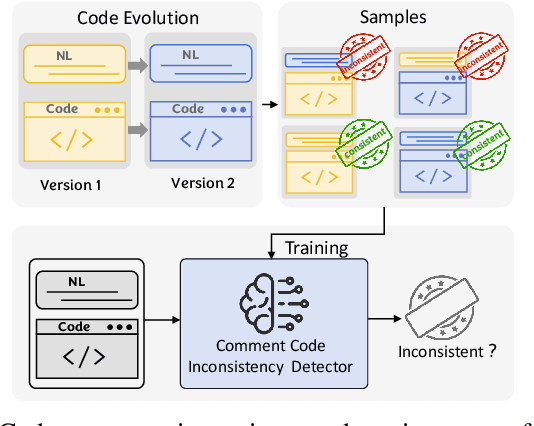
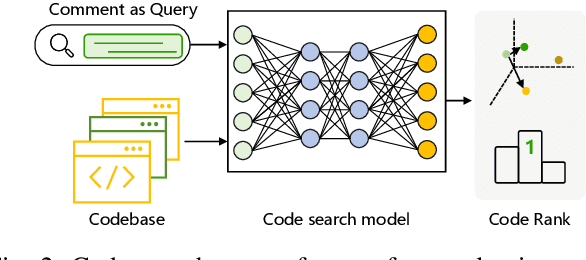
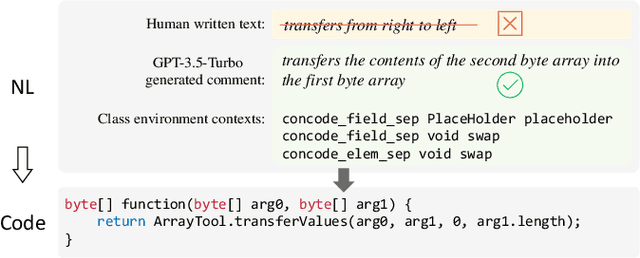
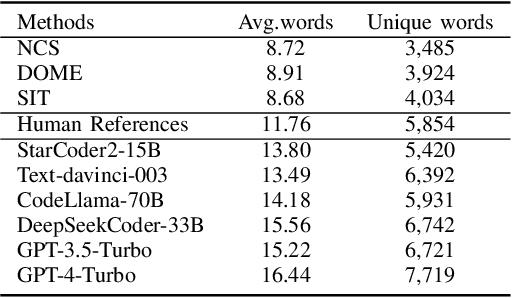
Pre-trained code models rely heavily on high-quality pre-training data, particularly human-written reference comments that bridge code and natural language. However, these comments often become outdated as software evolves, degrading model performance. Large language models (LLMs) excel at generating high-quality code comments. We investigate whether replacing human-written comments with LLM-generated ones improves pre-training datasets. Since standard metrics cannot assess reference comment quality, we propose two novel reference-free evaluation tasks: code-comment inconsistency detection and semantic code search. Results show that LLM-generated comments are more semantically consistent with code than human-written ones, as confirmed by manual evaluation. Leveraging this finding, we rebuild the CodeSearchNet dataset with LLM-generated comments and re-pre-train CodeT5. Evaluations demonstrate that models trained on LLM-enhanced data outperform those using original human comments in code summarization, generation, and translation tasks. This work validates rebuilding pre-training datasets with LLMs to advance code intelligence, challenging the traditional reliance on human reference comments.
Towards an Understanding of Context Utilization in Code Intelligence
Apr 11, 2025Code intelligence is an emerging domain in software engineering, aiming to improve the effectiveness and efficiency of various code-related tasks. Recent research suggests that incorporating contextual information beyond the basic original task inputs (i.e., source code) can substantially enhance model performance. Such contextual signals may be obtained directly or indirectly from sources such as API documentation or intermediate representations like abstract syntax trees can significantly improve the effectiveness of code intelligence. Despite growing academic interest, there is a lack of systematic analysis of context in code intelligence. To address this gap, we conduct an extensive literature review of 146 relevant studies published between September 2007 and August 2024. Our investigation yields four main contributions. (1) A quantitative analysis of the research landscape, including publication trends, venues, and the explored domains; (2) A novel taxonomy of context types used in code intelligence; (3) A task-oriented analysis investigating context integration strategies across diverse code intelligence tasks; (4) A critical evaluation of evaluation methodologies for context-aware methods. Based on these findings, we identify fundamental challenges in context utilization in current code intelligence systems and propose a research roadmap that outlines key opportunities for future research.
How Well Do LLMs Generate Code for Different Application Domains? Benchmark and Evaluation
Dec 24, 2024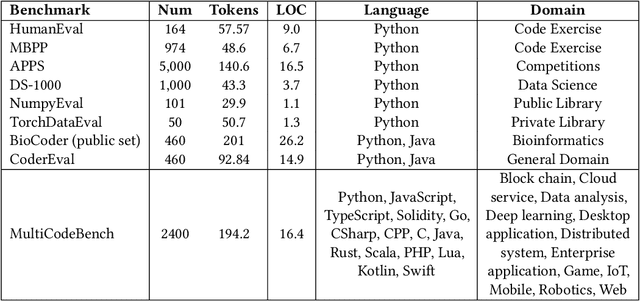

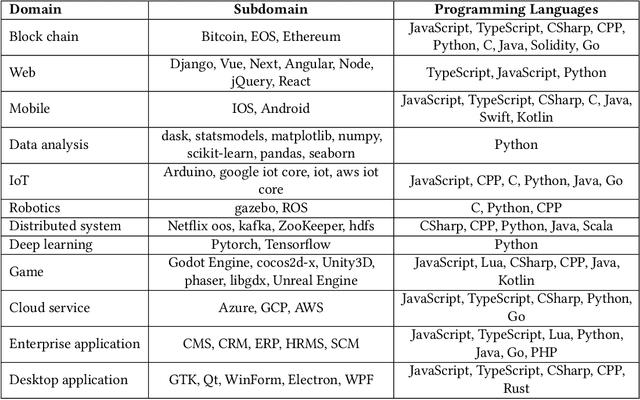

Recently, an increasing number of AI-driven programming assistants powered by code LLMs have been integrated into various real-world software development environments, significantly boosting developer productivity. However, existing code generation benchmarks primarily focus on general-purpose scenarios, leaving the code generation performance of LLMs for specific application domains largely unknown. In this paper, we introduce a new benchmark, MultiCodeBench, to fill this gap. MultiCodeBench comprises 2,400 programming tasks, covering 12 popular software development domains and 15 programming languages. Specifically, we perform in-depth research to identify these 12 application domains. Given that each domain may involve multiple technical frameworks, and that different frameworks present distinct challenges in the coding process, we categorize the commonly used frameworks and platforms within each domain. We then sample programming problems from GitHub repositories related to these subdomains. To ensure the quality of the tasks and mitigate data leakage issues, we invite annotators to rewrite the docstrings for each task in MultiCodeBench. Additionally, we build a static analysis-based dependency parsing tool to extract the dependencies in the ground truth for each task, enabling deeper performance analysis. Through extensive experiments on MultiCodeBench with eleven representative mainstream LLMs, we reveal the code generation performance of the LLMs across different application domains, providing practical insights for developers in downstream fields when selecting LLMs. Furthermore, we analyze the reasons behind the models' failures in completing software application development tasks, offering guidance for model developers to enhance domain-specific code generation capabilities.
RepoTransBench: A Real-World Benchmark for Repository-Level Code Translation
Dec 23, 2024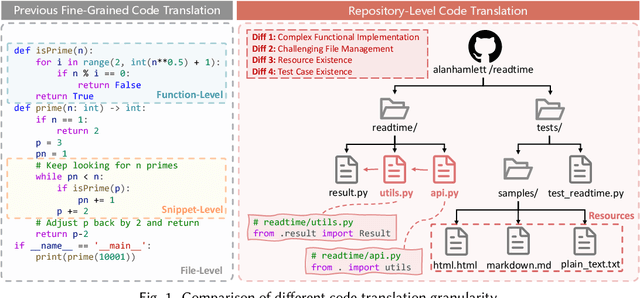
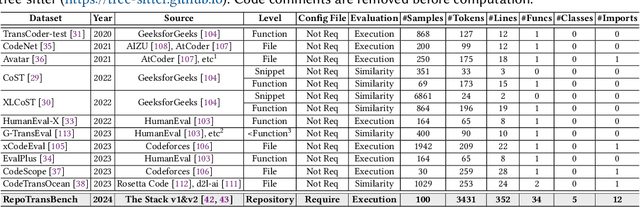

Repository-level code translation refers to translating an entire code repository from one programming language to another while preserving the functionality of the source repository. Many benchmarks have been proposed to evaluate the performance of such code translators. However, previous benchmarks mostly provide fine-grained samples, focusing at either code snippet, function, or file-level code translation. Such benchmarks do not accurately reflect real-world demands, where entire repositories often need to be translated, involving longer code length and more complex functionalities. To address this gap, we propose a new benchmark, named RepoTransBench, which is a real-world repository-level code translation benchmark with an automatically executable test suite. We conduct experiments on RepoTransBench to evaluate the translation performance of 11 advanced LLMs. We find that the Success@1 score (test success in one attempt) of the best-performing LLM is only 7.33%. To further explore the potential of LLMs for repository-level code translation, we provide LLMs with error-related feedback to perform iterative debugging and observe an average 7.09% improvement on Success@1. However, even with this improvement, the Success@1 score of the best-performing LLM is only 21%, which may not meet the need for reliable automatic repository-level code translation. Finally, we conduct a detailed error analysis and highlight current LLMs' deficiencies in repository-level code translation, which could provide a reference for further improvements.